RAINBOW News

The Ongoing Russian-Ukrainian War and Its Impact on Agricultural Commodity Prices

BY Henco Reyneke, Procurement Executive EPOL

The persistent conflict between Russia and Ukraine has far-reaching consequences that extend beyond geopolitical borders. The global agricultural market is one significant area feeling the ripple effects of this conflict. Agricultural commodity prices are intricately linked to the stability of nations and the smooth functioning of international trade. As tensions escalate and uncertainty grows, the agricultural sector faces a series of challenges that have the potential to reshape commodity prices worldwide.

Impact on Agricultural Production

Ukraine is known as the “breadbasket of Europe” due to its fertile soil and significant agricultural output. The ongoing conflict has disrupted agricultural production, leading to concerns about the availability of staples such as wheat, corn, and sunflower oil. Conflict-related disruptions, including the destruction of farmland, displacement of farmers, and logistical challenges, can lead to reduced agricultural output and potentially higher prices for these commodities on the global market.

Supply Chain Disruptions

The Russian-Ukrainian conflict has also led to disruptions in transportation and trade routes. Ukraine serves as a key transit country for various commodities moving between Russia and Europe. Any disruption in transportation networks can hinder the flow of goods, including grains and other agricultural products. These supply chain disruptions can lead to delayed shipments, increased transportation costs, and potential shortages, all of which contribute to upward pressure on commodity prices.

Investor Sentiment and Speculation

The ongoing conflict has heightened uncertainty in financial markets, leading to increased investor speculation. Agricultural commodity markets are not immune to this phenomenon. Investors seeking safe havens and hedging against potential supply shocks may turn to agricultural commodities, further influencing price movements. The interconnectedness of global markets means that even perceived changes in supply or demand can trigger significant price fluctuations.

The Russian-Ukrainian conflict has cast a shadow of uncertainty over the global agricultural commodity markets. Disruptions to production, supply chains, investor sentiment, and government policies all contribute to the potential for increased price volatility. As negotiations and tensions continue to unfold, the agricultural sector must navigate these challenges and adapt to changing market dynamics. While the full extent of the conflict’s impact on agricultural commodity prices remains uncertain, it serves as a reminder of the intricate connections between geopolitical events and the world’s food supply.

Henco Reyneke, Procurement Executive EPOL

Related Posts

Tjokkers Rugby Development Clinic a Huge Success in Worcester

Tjokkers Rugby Development Clinic a Huge Success in Worcester

Worcester, 19 August 2026: On Saturday, 15 August 2026, the Worcester Villagers Rugby Club was once again a hive of activity and endless excitement as the hosts teamed up with Rainbow Chicken and the Sanlam Boland Kavalier to host close on 100 young aspiring rugby players at a development clinic.

Press Release Results for Year Ended June 2026

Press Release Results for Year Ended June 2026

“By consistently advancing our five strategic pillars; operational efficiencies, competitive procurement, future-proofing the business, unlocking people potential, and strengthening market-facing capabilities, Rainbow continues to improve its operational resilience and competitiveness. This strategic focus enables us to deliver quality, affordable products to customers and consumers, adapt to changing market dynamics, and support long-term value creation while contributing meaningfully to South Africa’s food system.”

The Women reshaping modern agriculture

The Women reshaping modern agriculture

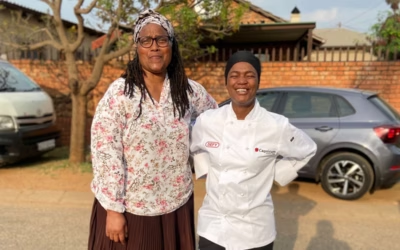
The stereotype of agriculture has not kept pace with reality. Modern food production is no longer defined solely by farms and livestock. It is an industry shaped by science, technology, innovation and operational excellence, requiring expertise that spans everything from artificial intelligence and food safety to packaging engineering and production management.

Rainbow employees celebrate Mandela Day by strengthening schools in local communities

Rainbow employees celebrate Mandela Day by strengthening schools in local communities

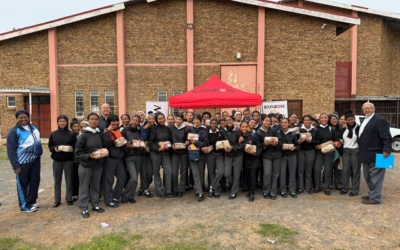
This year’s Mandela Day theme, “It’s still in our hands to combat poverty and inequity,” called on people around the world to dedicate their time, skills and resources to uplifting their communities. Rainbow Chicken employees in KwaZulu-Natal embraced that call by volunteering at two schools, helping create better learning environments for hundreds of children.

Strategic Expansion

Strategic Expansion

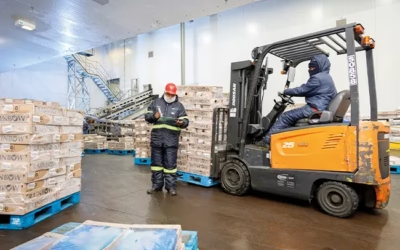
As SA’s agricultural sector navigates a competitive and complex operating environment, exports are becoming an increasingly important strategy for growth and diversification.

Meals that matter: Rainbow Rustenburg feeding futures

Meals that matter: Rainbow Rustenburg feeding futures

As one of the region’s largest employers and a long-standing neighbour to local schools, Rainbow Rustenburg has embedded a culture of giving back into its community. This commitment extends into the lives of thousands of learners, strengthening education, food security, and community well-being through practical, lasting support.